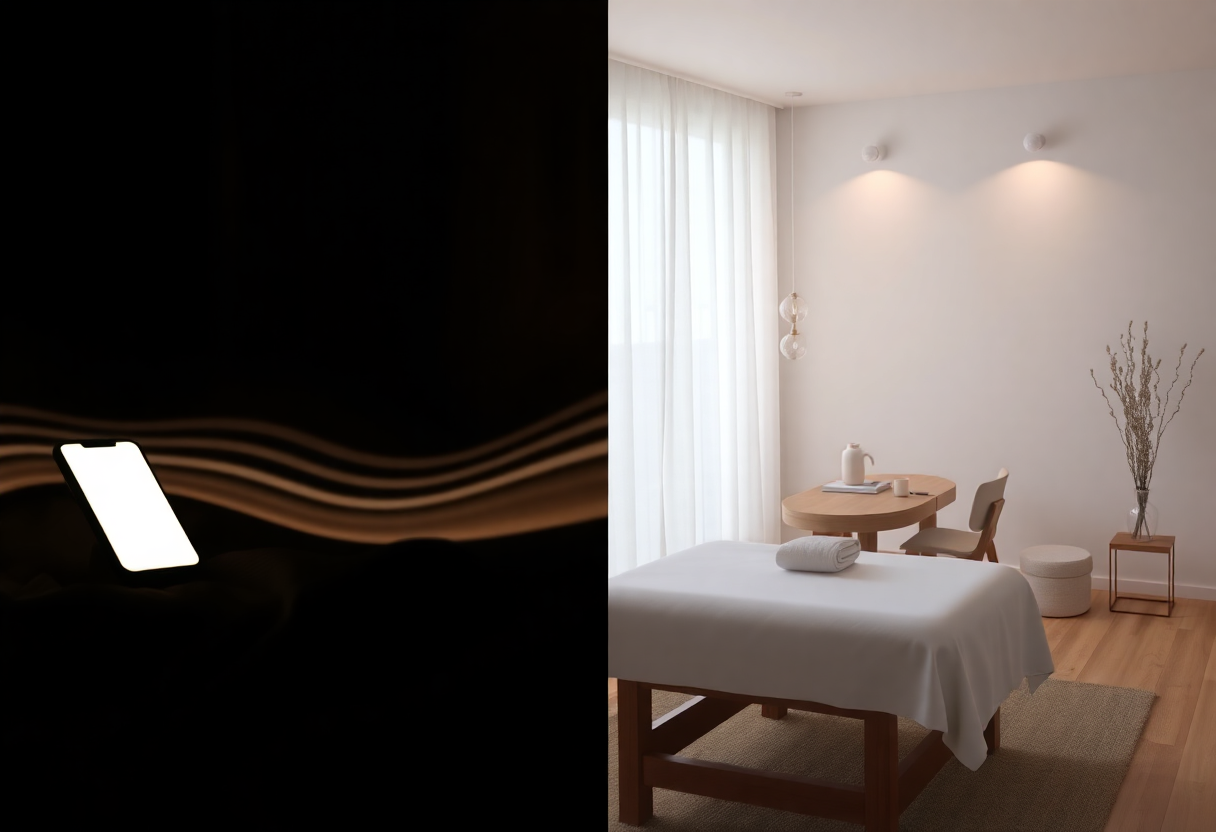
It's Friday, 6:47 PM. Sarah has a $95 energy work session booked for 7:30 across town. Traffic's building, she hasn't eaten, and her partner just asked what's for dinner. She's got a decision to make in the next four minutes: get in the car, or cancel and open the frequency wellness app she's been subscribing to for two months. This is the actual decision point most people face, and it's the reason the whole "remote energy healing vs in-person" question deserves a more honest answer than either camp usually gives.
The wellness internet loves to frame this as a binary. Purists insist nothing replaces hands-on work with a skilled practitioner. Tech evangelists insist apps and remote sessions have democratized what used to be gatekept. Both are partially right and both are missing what actually determines whether either format works for you: consistency friction. More on that later. First, let's be clear about what we're actually comparing.
What We're Actually Comparing: Remote vs In-Person Defined
Remote frequency wellness sessions explained
Remote frequency wellness covers a spectrum. On one end you have distance healing practitioners who work with you over Zoom or asynchronously. On the other end you have app-based platforms like Qiari, which deliver structured frequency experiences through your phone or desktop, personalized by an AI layer that adapts to your stated intentions and patterns over time. No hardware, no practitioner on the call, no travel. You pick an intention (sleep, focus, calm, energy), the platform serves you a session, you engage with it wherever you are.
The core promise: you can maintain a frequency wellness practice from a hotel room in Tokyo, your kitchen at 6 AM, or the corner of a coworking space. If you want the full breakdown of the format, the remote frequency wellness guide covers the mechanics.
In-person energy work: what you're paying for
In-person energy work, whether that's Reiki, sound baths, biofield tuning, acupuncture with an energetic component, or something more esoteric, is a completely different transaction. You're paying for a specific human's attention, their training, their space, and the somatic experience of being physically present while someone works with you. A skilled practitioner reads things a screen can't read: micro-shifts in your breathing, temperature changes in your hands, the quality of your silence. That's real, and it's genuinely hard to replicate.
You're also paying for the ritual container. The drive there, the waiting room, the smell of the space, the moment you lie down on the table. Ritual matters more than most tech people admit.
The Logistics Reality: Time, Travel, and Friction
In-person requires you to show up; remote doesn't
A 60-minute in-person session is rarely a 60-minute commitment. Add 20 to 40 minutes of travel each way, 10 minutes of buffer, maybe a shower afterward. You're looking at a two-hour block for a weekly session. Multiply that across a year and you're spending 100+ hours in logistics just to receive the work.
Remote sessions collapse this. A 15-minute Qiari session is 15 minutes. That's it. You can do one before a meeting, one during a lunch break, one before bed. The daily practice framework is built around that reality.
The hidden cost of consistency with distance work
Here's where it gets interesting, and where most comparison articles lie by omission. Yes, remote is more convenient per session. But convenience is not the same as consistency. In fact, the low friction of remote work is often why people fall off. If a session costs $95 and requires you to drive across town, you show up. That artificial accountability, the sunk cost, the appointment on your calendar, the fact that a real human is expecting you, produces behavior. Remove all of that and suddenly a lot of people find their remote practice gathering digital dust.
This is the honest angle nobody wants to say out loud. In-person creates accountability through logistics. Remote requires accountability through habit design.
When in-person actually wins on convenience
Counterintuitively, in-person can be more convenient in one specific situation: when you have a hard time doing anything for yourself alone. If your baseline is that self-directed practices always dissolve into scrolling or falling asleep on your phone, paying someone to hold space for you might actually be the cheaper option in the long run, because you'll actually do it.
The Personalization Question: AI vs Intuition
How remote AI-powered platforms adapt to you over time
The pitch for AI-driven platforms is that personalization deepens with use. You tell the system you slept badly, you're prepping for a stressful week, you want energy in the mornings and calm in the evenings, and it schedules and adapts accordingly. The AI personalization layer is designed to do exactly this: learn your patterns, adjust session pacing, surface intentions you keep coming back to. It's not magic, but it's real, and it gets better the longer you use it.
What an in-person practitioner brings that algorithms can't
An algorithm doesn't notice that your left shoulder is holding more than your right. It doesn't feel that your energy is scattered today in a way that suggests a specific approach. A seasoned practitioner integrates hundreds of small perceptual data points that current AI simply cannot access. If you're working through something specific and complex, especially trauma-adjacent or deeply somatic, a good practitioner is going to serve you better than an app.
That said, most people are not working through trauma-adjacent complexity. Most people want to sleep better, feel less scattered, and drop into calm more easily. For those goals, the personalization gap narrows dramatically.
The learning curve difference between formats
In-person you show up and the practitioner drives. Learning curve: near zero. Remote work, especially with app-based platforms, has an actual learning curve. You need to understand how to choose the right session, how to set intentions, how to build a routine. Not steep, but non-trivial. The beginner's first month guide exists because this ramp is real.
Price: What You're Actually Spending
Remote subscription costs vs in-person session rates
In-person energy work in most North American cities runs $80 to $200 per session. Once a week, that's $4,000 to $10,000 a year. Once a month, $1,000 to $2,400. Qiari subscription tiers, detailed in the current pricing breakdown, run a small fraction of that annually, and you get unlimited sessions.
The math is not close. Financially, remote wins by an order of magnitude.
The cumulative cost of consistency (which format favors your wallet)
The real question is cost per useful session. If you pay for a subscription and use it three times in six months, the per-session cost approaches your car payment. If you book six in-person sessions and attend all six, your per-session cost is exactly the sticker price. This is why the friction pattern discussion matters. The subscription vs hardware cost analysis breaks the economics down further, but the principle is the same for practitioner work: what you actually do determines what you actually pay per useful outcome.
Hidden expenses in each model
In-person hidden costs: gas or transit, occasional parking, tips if you tip, food you buy on the way home because you're spent, the time-value of the hours in transit. Remote hidden costs: the phone or laptop you already own, occasional wifi issues, the discipline tax of doing self-directed work.
The Relationship Factor: Accountability and Connection
Does remote work if you're new to frequency wellness
Beginners often assume they need a practitioner to introduce them to this world. Sometimes true, often not. For many people, starting remote is actually easier because there's less social pressure, no need to explain your skepticism, no awkwardness of lying on a table while a stranger hovers. You get to explore privately. The distance frequency guide is useful reading if you're on the fence.
In-person accountability structures and why they matter
You booked it. You paid a non-refundable deposit. Someone is expecting you. These are not small forces. Human commitment devices work, which is why gyms with trainers get better client outcomes than gyms without, even when the workouts are identical.
How Qiari handles the motivation piece without a practitioner
Qiari's approach is to build accountability into the app layer through scheduled sessions, gentle reminders, and personalization that references your recent history so it doesn't feel like starting from scratch each time. It's not equivalent to a practitioner expecting you, but it's not nothing. The signup and first week guide walks through how the platform tries to bridge this gap early.
Who Should Choose Which Format
Remote is winning for these specific situations
Choose remote if: you travel frequently, your schedule is unpredictable, you want to explore before committing significant money, you have a private space at home, you're comfortable with self-directed practices generally (do you actually meditate on the app you downloaded? that's your tell), or you want to layer frequency wellness across many small moments of your day rather than as a single weekly event.
In-person still makes sense here
Choose in-person if: you have specific complex issues you're working through, you know from history that self-directed practices don't stick for you, you deeply value ritual and physical space, you have a practitioner you already trust and connect with, or you want the deeper relational field that only develops over time with the same human.
The hybrid approach (why many people do both)
The most sophisticated users of this space, honestly, do both. Weekly or monthly with a trusted practitioner for depth work, daily remote sessions for consistency and maintenance between visits. They're not competitors, they're different tools for different jobs.
The honest answer to remote energy healing vs in-person isn't which is better. It's which friction pattern matches your actual behavior. If you know you'll flake without an appointment, in-person. If you know you'll never carve out a two-hour block weekly, remote. If you're being real with yourself and you have the budget, both.
Your Next Step: Finding Your Resonance Format
The wellness industry loves to sell you the answer. What you actually need is to figure out how you actually behave. Ten minutes tonight, before you overthink this any further, ask yourself which format your last three months of behavior would support. That's your answer, not what sounds most spiritual or most modern.
If remote is the honest fit, or if you just want a low-stakes way to test whether frequency work does anything for you before booking a $150 session across town, the fastest way to feel your own RESONANCE is to run a few personalized sessions this week and pay attention to what shifts. You'll know more from three real sessions than from three months of reading about the topic.
Qiari is a wellness experience, not a medical treatment. Consult a qualified healthcare provider for medical conditions.